

Diamond & Metals
We are a full-service jewelry retailer with experts in all related fields. Scroll down for insights from our experts into how to buy and care for fine jewelry.
About Diamonds
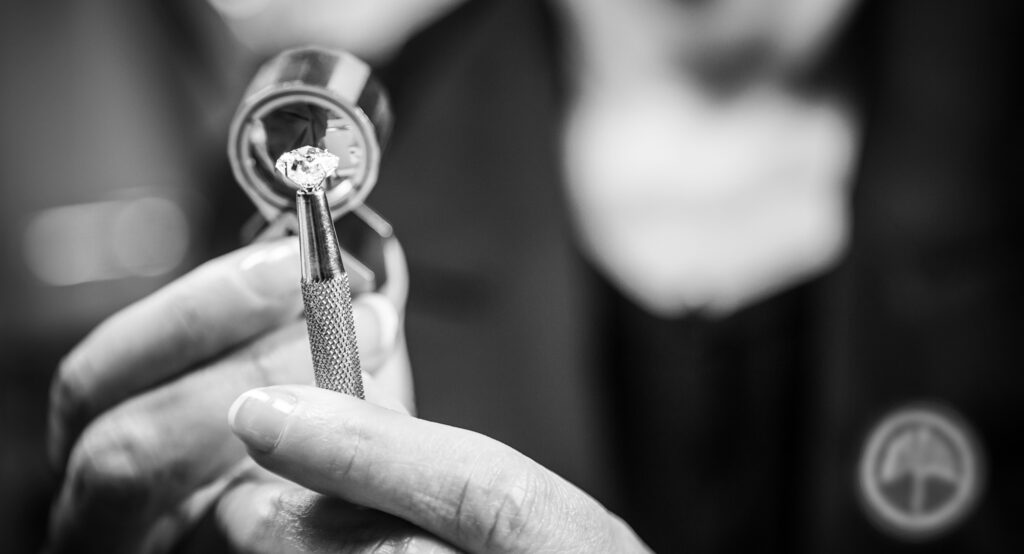
Timeless Symbols of Love and Craftsmanship
Discover how to make informed decisions when purchasing a diamond. Learn the essentials of diamond grading and understand why trust and certification standards matter. Access expert insights and videos on the 4C’s to guide your perfect choice.
About Lab Grown Diamonds

What You Need to Know
Uncover the facts about Lab-Grown Diamonds (LGDs) and navigate through the common misconceptions. Learn about the economic realities of LGDs and why understanding their pricing trends is essential for informed decision-making.
Read More
What are Lab-Grown Diamonds?
Unlike natural diamonds which are formed over millions of years deep beneath the earth’s surface, LGDs are “grown” in a lab using sophisticated technology. There are two ways to make LGDs:
- HPHT (High Pressure High Temperature) – this is an older method and uses a lot of energy.
- CVD (Chemical Vapor Deposition) – this method uses superheated carbon-rich gases that are ionized in order form the diamond in layers.
Often CVD diamonds are finished with an HPHT process. In all cases, LGDs are very energy intensive, so, contrary to popular belief, their carbon footprint can be very high. This is particularly true in areas where electricity is generated using fossil fuels.
Both methods can yield a diamond in a few weeks. The result is an actual diamond that is physically and chemically the same as a natural diamond. LGD technology is improving each year and we are already at a point where the 4 C’s of an LGD can be comparable to a high-quality natural diamond.
Note that LGDs are distinct from “simulated diamonds” such as Moissanite and cubic zirconia; these are not diamonds at all, but are made to look like diamonds.
Distinguishing LGDs from Natural Diamonds
Natural and man-made diamonds have the same chemical properties, but they are not identical. The vastly different conditions under which they are formed leave differences at the atomic level which enables specialized equipment to tell them apart.
Specialized equipment to test for LGDs (based on the diamond’s fluorescence and phosphorescence, etc.) is becoming more prevalent and more accurate. In addition, diamonds of any significant size sold by reputable dealers include a laser inscription on the diamond girdle. One can always tell from the inscription whether the diamond is natural or man-made (though sometimes this may require a reference check of the inscription number with a lab).
A major implication of this detectability is that there is no “risk discount” for natural diamonds, i.e., given that we can always prove a diamond is natural, there is no risk that its value could be discounted because of uncertainty surrounding its provenance.
The technology factor and pricing
LGDs are highly dependent on evolving technology. Both manufacturing processes are benefiting from the relentless and substantial improvements in technology every year. This means that LGDs will become cheaper to produce every year. With competition and with an increasing supply, the retail prices of LGDs will also decline over time, as we have seen in the recent past.
The competition in LGD manufacturing will be intense because there will be many new non-jewelry uses for LGD, beyond the current industrial uses. The silicon used in microchips will eventually be replaced by LGD, and this will bring very large players into the field, who will deploy even more resources towards better technology – which, in turn, will lower prices further.
We do indeed see that LGD prices continue to come down. While there is much more variation in price in LGDs than in natural diamonds, on average they are selling below 25% of the price of a comparable natural diamond (i.e., more than 75% discount). In some cases, the discount is as high as 99%.
In contrast, many believe that the supply of natural diamonds will shrink in future because it will become harder and harder to extract natural diamonds from the earth.
Our view on LGDs in fine jewelry
Stittgen Fine Jewelry prides itself in creating and selling high-quality jewelry that will stand the test of time. Implicit in this promise is the understanding that our products will not be significantly devalued over time. More specifically, we will not sell the same product at a substantial discount in future. This is why we almost never have sales, whereas many other jewellers have “up to 80% off” sales regularly.
The primary concern with selling LGDs is that we would be selling something we know will retail for a lower price in a year or two. This does not align with our core values. We are not trying to make a judgement call or say that there’s something wrong with LGDs; we just feel it’s very important that our clients understand the true “value” of their lab grown diamond, and that it will retail for less, not more, in future. It is also important to note that the vast majority of LGDs have no resale value.
Our clients are purchasing or commissioning pieces that will have meaning, not just for them but also for those that the piece will be passed on to. A Stittgen piece is treasured for a long time. Often a significant investment is made, with the understanding that even though the price of gold and natural diamonds fluctuates, they are intrinsically “precious” and will always be. This is particularly important for jewelry to commemorate life events such as engagements and major anniversaries.
On the other hand, our objective is only to educate and provide the best advice we can. If a client, after considering the foregoing, is still convinced that LGDs are more appropriate for them at this juncture, then we can easily source suitable LGDs for them. We have done exactly that for a young couple that has always wanted a Stittgen ring, but due to short-term budget constraints, wanted an LGD until they could buy a “permanent” natural diamond.
At Stittgen, our mission is to create treasured pieces of enduring beauty and quality that have meaning for you. We are here to facilitate turning your vision into reality.
About Precious Metals

Find the Perfect Match for Your Custom Jewelry
With so many different types of precious metals on the market, it can sometimes be difficult to select or distinguish between the various options. At Stittgen Fine Jewelry, clients have the opportunity to work with our team on creating their custom pieces utilizing a variety of precious metals, such as yellow gold, white gold, platinum, and rose gold.
Traditionally, yellow gold, white gold, and platinum have been the popular choices for wedding bands and rings, as well as necklaces and bracelets. Yellow gold is very symbolic and is the most malleable of all the precious metals. White gold and platinum look similar, but are very different in terms of composition. 19K white gold has high luster and does not need Rhodium plating to achieve the white colour, but it is harder to work with than lower karat white gold. Platinum on the other hand is extremely durable, and is the purest of all of these metals, as it is mixed with very small quantities of other metals when creating jewelry.
Rose gold, which is a blend of yellow gold and copper, has made a resurgence in popularity with its pinkish hue. “We are definitely seeing more couples going with rose gold for their wedding bands, be it combined with white gold into a two-tone design or on its own,” says Stittgen’s Selina Ladak. “It is a growing trend, with many appreciating the antique look provided by rose gold.”